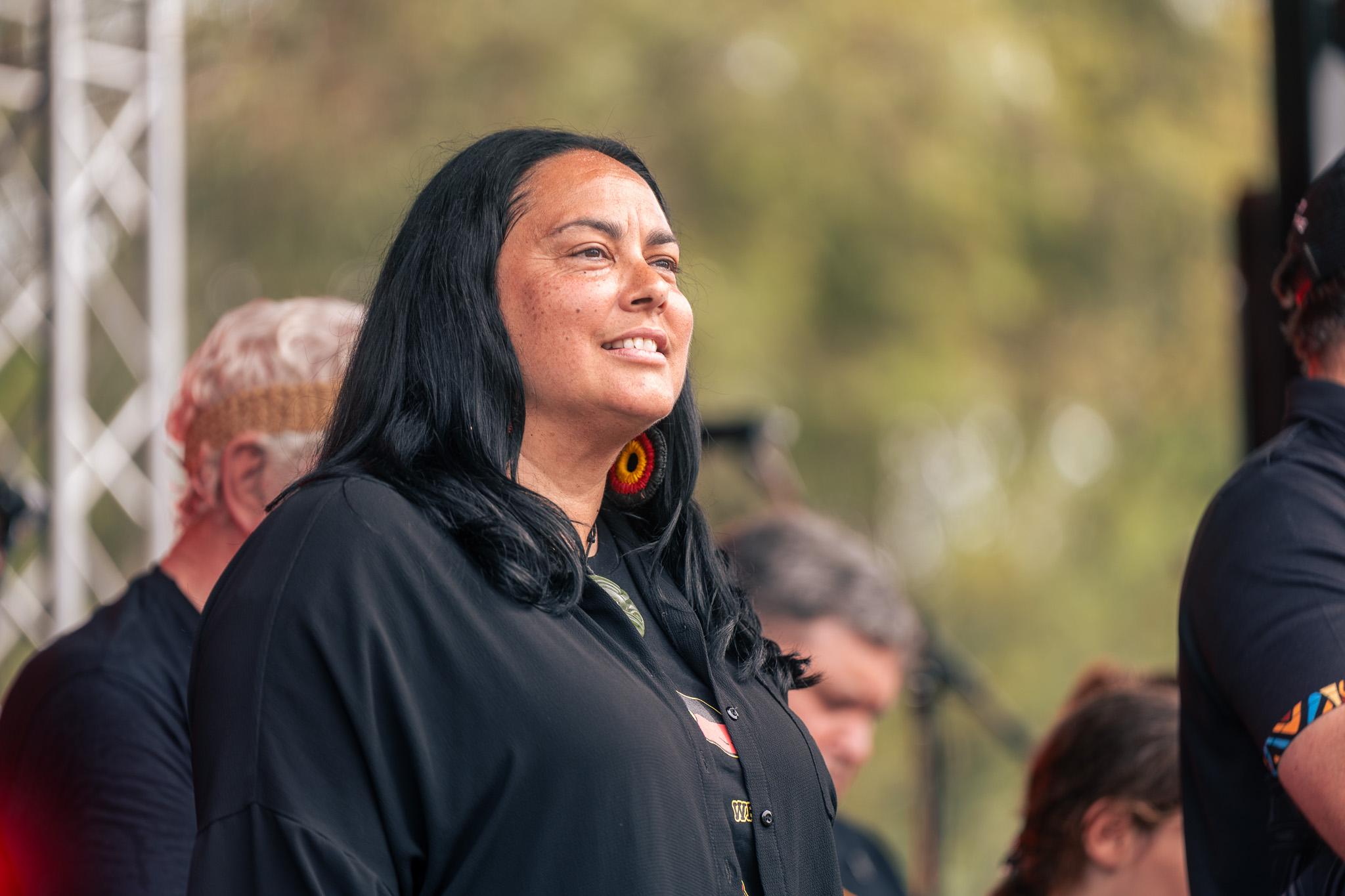
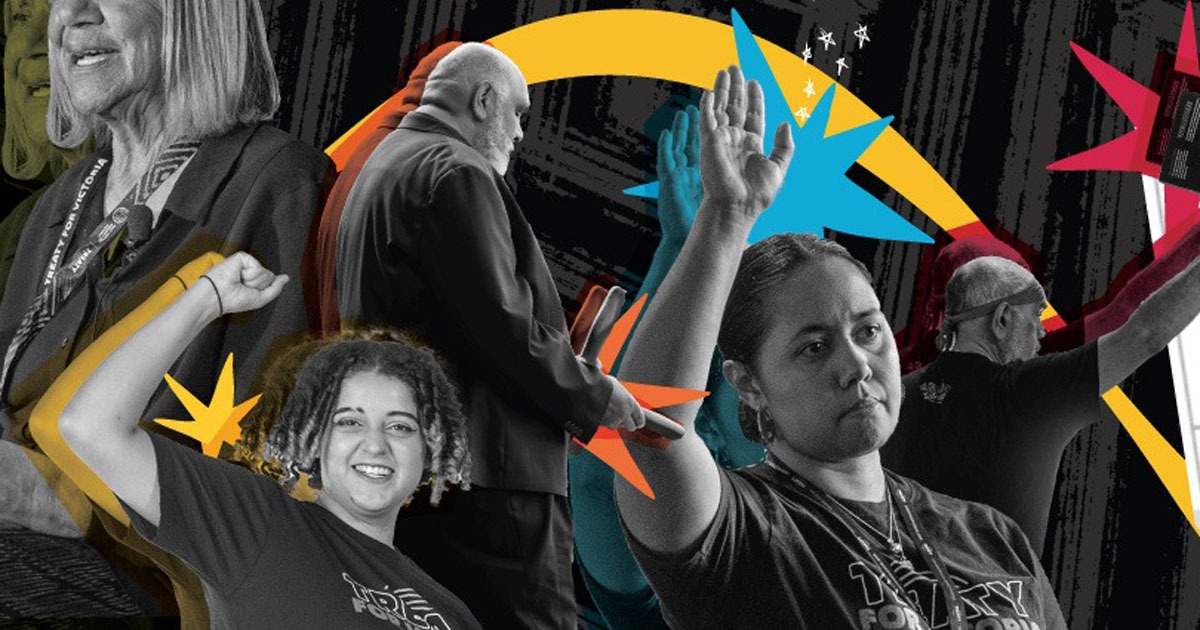
I am a Gunnai man who was born and raised in Orbost, East Gippsland and a career that spans well over 30 years. I have a deep understanding and strong connection to my cultural identity and community. I will bring these many years of experience to assist with the development of a Treaty for Victoria and that the process is inclusive, engages via First Peoples to increase their awareness and understanding of what it means for individuals, families and the community.
For the past 30 plus years, I have worked to support Aboriginal people and communities by leading and shaping government policy and strategies that focus on addressing Aboriginal social and economic disadvantage. I will continue to lead and advocate for the removal of barriers that impact on Aboriginal people’s ability to achieve their goals and aspirations.
I am committed to improving the socio-economic health and wellbeing outcomes for First Peoples and to advocate for stronger recognition of mob who live in small and regional communities. I will work collaboratively to ensure we can develop a framework to advance a Treaty for First Peoples of Victoria.
Member Updates
November 2025 — Meeting of Assembly at Mildura
Reporting Period: 18 August – 15 November 2025
Introduction
This period revolved around the hard work required to support the Treaty legislation as it moved through the Victorian Parliament and toward its historic signing. A substantial amount of time was spent attending briefings, participating in joint Assembly actions inside Parliament, and ensuring Members were present to witness the bill progressing through both houses.
Alongside this, I focused on keeping communities across the South East informed about what this transition means for them. Regular conversations, meetings, and updates ensured community voices continued to guide my work.
A major and historical milestone was reached with the signing of the Treaty Bill by all 33 Assembly Members at Birrung Wilam on 12 November, followed by Royal Assent at Government House on 13 November. These events marked a defining moment in Victoria’s Treaty journey.
Ongoing Work Priorities
• Represent the South East region in all Assembly business, ensuring local priorities and concerns inform decision-making.
• Maintain clear communication with community about the transition from the Assembly to Gellung Warl.
• Support and witness the passage and implementation of the Treaty legislation.
• Strengthen relationships with regional organisations, cultural leaders, and community groups.
Key Engagement and Assembly Activities
Focus Areas This Period
Most of the work between late August and mid-November centred on:
- Attending briefings and meetings essential to progressing the Treaty Bill through Parliament.
- Ensuring alignment across Assembly Members on messaging, preparation, and decision-making.
- Participating in discussions shaping the transition work required for Gellung Warl to commence in July 2026.
- Supporting legal, cultural, and ceremonial processes in the lead-up to the signing events and other planning matters linked to recognition and celebration on 12 December.
Major Milestones Achieved
- 12 November: Treaty Bill signed by all 33 Assembly Members – Ceremonial signing at Birrung Wilam
- 13 November: Royal Assent granted – Granted at Government House
- 13 November: Formal proceedings at Government House – Completion of ceremonial requirements
Community Information and Engagement
Throughout this period, communities across the South East sought clear, accessible information on the legislation and what lies ahead. Key topics covered during presentations, conversations, and informal sessions included:
- What the Treaty legislation does and doesn’t do.
- How the transition to Gellung Warl will occur.
- What community representation will look like during and beyond the transition.
- The importance of local voices and cultural authority in shaping the next stage.
- Increased interest in the upcoming Member election process.
Themes Raised by Community
- Transition Clarity: Strong interest in timelines and responsibilities between now and July 2026
- Representation: Questions about how Gellung Warl will structure community involvement
- Truth-telling and Governance: Continued emphasis on localised authority and future rights negotiations
- Communication: Need for culturally safe, direct engagement
- Far East Gippsland Concerns: Requests for dialogue with Treaty Authority and Self-Determination Fund regarding non-recognised RAP groups (Manero, Bidwell Maap, Nindi Nguaran Ngarigo Monero)
Meetings and Engagements Across the South East
Barrithbarrith Gathering Place – Ongoing Partnership (Aug–Nov)
Work continues with the Barrithbarrith Gathering Place committee to scope and develop a plan for establishing a gathering place in the Bass Coast corridor.
Key Activities
- Chairing Yananhat partnership meetings involving: Bass Coast Shire, Westernport Water, Bass Coast Health, and Phillip Island Nature Parks.
- Chairing Barrithbarrith Gathering Place meetings, including sessions with consultants to design the long-term plan and discussions with Bass Coast Shire regarding land availability and building a case for infrastructure and grant funding
- Engaging with potential partner organisations to support the project.
- Providing guidance on establishing an ASIC-registered Company Limited by Guarantee as the governance structure.
- All work undertaken voluntarily in partnership with key Elders and acknowledged by the Bunurong Aboriginal Land Council.
Other Engagements and Events
- 28 August: Gippsland Aboriginal Economic Development Steering Committee: Contributed to developing an operational plan supporting regional entrepreneurs and business operators
- September: West Gippsland CMA – Final Board Meeting: Completed final meeting marking conclusion of a four-year board term
- 17 October: Bidwell Full Members Meeting (Bairnsdale): Presented update on Treaty Bill progress; encouraged enrolment and participation in FPAV processes
- 15 November: Switchboard Victoria AGM (Victorian Pride Centre, St Kilda): Engaged with LGBTIQA+ community organisation offering care, connection and support
FPAV Attendance Overview (25 Jun – 31 Oct 2025)
- Meetings required to attend: 20
- Meetings attended: 19
- Percentage attendance: 95%
Looking Ahead
- Continue strengthening community understanding of Treaty and the shift to Gellung Warl.
- Maintain consistent regional engagement, particularly with groups seeking greater clarity on governance and future opportunities.
- Support the next phase of operational and legislative transition work toward July 2026.
- Keep South East priorities at the forefront of Assembly planning.
- Increase enrolments and visibility across the South East region.
- Maintain active engagement with communities in Far East Gippsland.
June 2025 — Meeting of Assembly at Halls Gap
As the Southeast region representative, I remain committed to advocating for our people, building understanding of the Treaty process, and ensuring the voices of our diverse communities are heard. This report provides an overview of my activities during the current reporting period, which included direct community engagement, participation in official Assembly business (as attached), and broader advocacy across local government, Aboriginal organisations, and Treaty-related forums.
My recent work priorities have included:
- Strengthen Treaty engagement across southeast communities, with emphasis on inclusivity and accessibility and will be an ongoing activity
- Promote data sovereignty, cultural safety, and localised governance priorities
- Support and advocate for community-driven initiatives, including Gathering Place development and economic self-determination
- Represent the region in all relevant First Peoples Assembly meetings, committees, and working groups
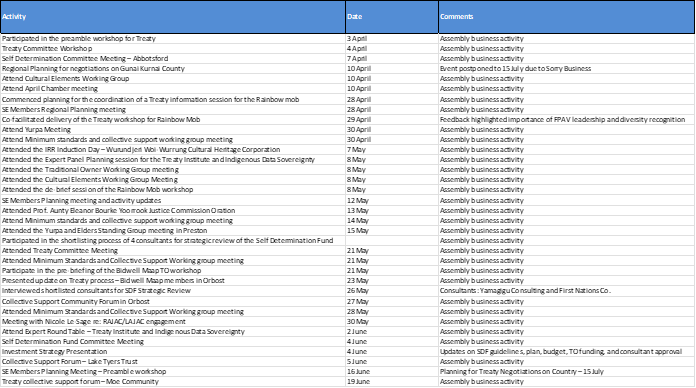
My recent engagement activities have included:
- 2 April: Provide Treaty update for Aboriginal staff of Dhumba Murmuk Djerring Unit, Court Services Victoria, Wattle Point Gippsland Addressed misconceptions around eligibility for Treaty, especially for Stolen Generations and non-TO Aboriginal staff. Provided up-to-date information about Treaty process and progress and responded to questions that emerged from the presentation.
- 14 April: Workshop- LEAHA Deyettyan Dardiganni Men’s Program Delivered Treaty education session; participants asked insightful questions and showed enthusiasm for future involvement and the need to be kept informed of future and ongoing progress.
- 29 April: Treaty Workshop- Rainbow Mob Feedback emphasised the importance of inclusivity and the need for safe spaces for all First Peoples identities. Participants valued being seen and included in early conversations and requested more regular engagement moving forward.
- 6-7 May: Local Government Engagement – Bass Coast and Latrobe City Councils Provided Treaty overview and discussed opportunities for local cultural immersion programs. Encouraged councils to consider Treaty in future planning and take advantage of opportunities to become informed.
- 14 May: Attended a stakeholder workshop for Barrithbarrith Gathering Place meeting at Millowl Approx. 20 service providers and agency staff attended the information session. There was strong support expressed for how best to collaborate and provide service delivery in the area. Presented information about Treaty and as a result, there is an opportunity for community engagement team to roll out ongoing information sessions in the area – demand is high.
- 16 May: Attended Elders Consultation at Wonthaggi for a Gathering Place Elders are supportive of the concept of a Gathering Place and is needed within the Bass Coast Region to bring community together. The Elders want to be kept up to date on the progress of Treaty negotiations – distributed Elders Voice newsletter.
- 23 May: Presented an update on the TO and State-wide Treaty process for the Bidwell Maap members in Orbost We commenced with a Smoking and welcome to country by members of the Bidwell Mapp. The workshop was well attended. The Bidwell Mapp secured funds from the SDF which has allowed the members to undertake research of their Apical ancestors resulting in a document with valuable information and stories. This information will help guide and underpin the process toward the realisation of reserved seat. The Treaty Authority were in attendance and Uncle Andrew Jackamos delivered a comprehensive and well-structured presentation about the functions, role of staff and their responsibilities. The information was well received and was delivered in a culturally inclusive and respectful way.
- 23 & 24 May: Met with CEO Moogji Aboriginal Council
- Met with community- one-on-one and kitchen table yarns Seeking staff support to attend the upcoming Treaty Forum in Orbost. A high-level overview of Treaty negotiations was provided, along with discussions about delivering future Treaty presentations to the community. These would offer opportunities for one-on-one or small focus group yarns. Planning is underway to schedule sessions and identify venues, with a focus on increasing visibility in the lead-up to during and after NAIDOC Week.
- Held one-on-one yarns with community in the Orbost area – concerns raised about communication gaps and that consideration for future information session to be delivered after hours or weekends to accommodate for people who work or have children in school.
- 26 May: Interviewed the two shortlisted consultants for the Self Determination Fund Strategic Review. The two consultancies interviewed were: Yamagigu Consulting – the largest First Nations consulting business in Australia; and First Nations Co. an Aboriginal-owned consulting firm committed to transforming systems and driving positive, lasting outcomes through collective knowledge
- 27 May: Collective Support Forum – Orbost. Co-Facilitated with Alice Pepper and Peter Hood, Southeast Elected members- Collective Support Community Forum in Orbost. See Summary notes below
- 28 May: Met with the Act. CEO of GLaWAC – general conversation pertaining to regional issues/ TO activities Purpose of the meeting was to introduce myself as the SE Elected Member and opportunities to discuss regional activities, TO business and casual Treaty yarns/conversations with staff in the workplace
- 5 June: Treaty collective support forum – Lake Tyers Trust Co-Facilitated with Alice Pepper- community information session on the progress of Treaty negotiations See summary notes below.
- 12 June: Attended a stakeholder workshop for Barrithbarrith Gathering Place meeting at Millowl The purpose of the meeting was to update stakeholder partners and other interested parties of the concept of Gathering places and types of support and opportunities they may be able to provide to grow the concept. Attendees were from Bass Coast Shire, Bass Coast Health, Westernport Water, Mylie Libraries, Phillip Island Nature Parks, South Gippsland and Bass Coast Reconciliation Group/Networks. Provided a snapshot of Treaty progress and an outcome is that there is a need for more nuanced information sessions to be delivered in the region along with targeted sessions with local Govt, Phillip Island Nature Parks and other interest groups.
- 16 June: SE Members Planning Meeting Preamble workshop Discuss and map out plan for the upcoming Treaty Negotiations on Country
- 15 July: Workshop and strengthen key sections/content of the previous Preamble working group discussions and advice from the Elders’ Voice. A draft has been distributed to the negotiation team for consideration and next steps.
- 17 June: SDF Strategic Review Project Kick-off On boarding process and introductions of First Nations Co and agree on the workplan moving forward
- 18 June: Yoorrook Justice Commission Report Attended the final leg of Yoorrook Justice Commission Walk to Victorian Parliament.
- 19 June: Treaty collective support forum – Moe Community Participated in the delivery of information to community on the progress of Treaty negotiations and gain feedback/input from attendees. See summary notes below.
Insights:
A summary of feedback from the three community forums is highlighted below and more detailed information was captured to inform and guide Treaty discussion/negotiations:
Orbost Golf Club
This forum provided a space for open and respectful discussion about local Treaty priorities. Key themes from the community included.
Education reform and racism in schools:
- Concern for high Koorie youth dropout rates linked to systemic racism
- Need for culturally safe support systems and more inclusive school curricula
- Families require stronger support when young people are in distress
- Data sovereignty and access to ancestral knowledge:
- Community stressed the importance of controlling their own data and narratives
- Called for access to museum and archival records to support proof of ancestry and identity
- Frustration that historical information is locked away while communities seek connection and validation
Localised Treaty implementation:
- Participants urged that Treaty be driven at the local level, tailored to community needs
- Belief that regional diversity must be recognised rather than applying one-size-fits-all frameworks
- Highlighted that strong local voices and actions are essential for long-terrn success
Regional isolation:
- Impacts on health and wellbeing, access to employment its limited, downturn in key industry is a reality and access to affordable housing requires a shift in focus as there are dedicated public housing stock that sit empty.
Lake Tyers Trust – Bung Yarnda
This gathering offered an opportunity for in-depth discussion around Treaty, culture, and the community’s aspirations for the future and the following summarise aspects of the forum.
Cultural knowledge and youth empowerment:
- Emphasis on teaching young people through community and lived experience, not colonial education models
- “We don’t need to change our knowledge to fit schools; schools need to change to fit us”
- Desire for self-defined learning centres with culture at the heart is a desired aspiration
- Self-determination and language:
- Community stressed using culturally relevant language, preferring “tribal groups” over “Traditional Owners”
- Urged clarity and consistency in Treaty language to avoid confusion or legal misinterpretation
- Highlighted the importance of naming and describing our ways in our own terms
Systems change and sovereignty:
- Participants expressed frustration with state systems and a lack of true autonomy
- Urged the Assembly to ensure real empowerment, not token participation
- Called for Treaty to challenge the status quo and drive systemic reform, not replicate colonial processes
The Aboriginal Lands Act 1970:
- Emerged as an area that allowed for a deep conversation to unfold with a focus on what will a Treaty do to address the challenges that currently impact on the community and its members ability to realise their aspirations and self-determination.
- There is limited opportunity to grow the economic base, limited resources that the Act. provides to facilitate a transition to real self-determination.
- The community is isolated, impacting community members capacity to access services that the wider community enjoy and take for granted – one example: access to public and reliable transportation to engage in community life off the Trust
Community Forum Moe
The session was co-facilitated by all Southeast region members and fostered a culturally safe and respectful environment that encouraged open dialogue, critical reflection on the Treaty process, and meaningful community-driven feedback aligned with local aspirations.
Strong Call for Accountability and Structural Change:
- Community members emphasised a deep frustration with both government and service providers who make promises but fail to follow through. There is a clear demand that systems, not Aboriginal people, need to change.
- Greater accountability for service providers and educational institutions.
- Embedding culturally safe practices into policy and making organisations responsible for ongoing support, not just one-off opportunities (e.g., Aboriginal traineeships).
- A call to legislate beyond symbolic “recognition” to deliver real change that is enforceable.
Prioritisation of Regional and Grassroots Development
- Participants expressed concern about Melbourne-centric Treaty work and highlighted the need for regional recognition and solutions that reflect local voices and priorities.
- Culturally grounded approaches developed from the grassroots up.
- More regular and accessible forums to continue discussions, particularly scheduled to accommodate community members’ availability (e.g., late-afternoon meetings).
Truth-Telling and Internal Community Healing
- A recurring theme was the importance of truth-telling – not only between Aboriginal and non-Aboriginal people, but also within First Peoples communities.
- The need to address lateral violence and internal division before or alongside broader Treaty processes (“Treaty between Blackfellas”).
- Emphasis on identity, culture, Custom and Lore as central to healing and moving forward.
- Desire for culturally grounded education for both younger generations and wider society.
Concerns About Sustainability and Youth Empowerment
- There was concern about the sustainability of Treaty progress and whether it will survive future political shifts.
- There was also robust discussion about bringing young people into leadership roles (e.g., Assembly 3.0) and building their confidence and capacity.
- Ensuring continuity of knowledge and avoiding “starting from scratch” with new leadership cycles.
- Calls for economic self-reliance and reducing dependency on government funding through long-term, community-led development.
Implementation:
To support stronger community engagement with Treaty, continue small-scale, place-based discussions that foster understanding and reduce disengagement, particularly among younger generations. Advocate for cultural learning models grounded in local language, values, and knowledge sharing. Ensure inclusive participation of underrepresented groups, including the rainbow mob and non-Traditional Owner community. Prioritise transparent, grassroots communication strategies to enhance the timeliness and accessibility of Treaty information.
As we move toward formal Treaty negotiations, I will continue supporting initiatives that uphold the principle of self-determination and where possible, empower community to lead. A stronger focus on sustained engagement, inclusive dialogue, and respect for diversity of mob are essential for a Treaty that is fair, just, and future-facing. I look forward to continuing to serve our Southeast communities with transparency and accountability and encourage members to reach out if there are questions and or concerns to be answered/raised and to encourage community and allies to enrol and become members of the First Peoples Assembly.
I want to give a big shout out to our amazing Southeast Engagement Team -their hard work and dedication make it possible for us, as Elected Members, to stay connected with mob right across Gippsland. The way they show up, support our work, and help create safe spaces for genuine yarns is something I’m grateful for.
March 2025 — Meeting of Assembly at Traralgon
Report from Brian Stevens, Gunai Representative for the Southeast Region of the First Peoples Assembly of Victoria.
As the Southeast Region Representative, I am committed to advocating for the aspirations of our communities, fostering engagement in the Treaty process, and promoting self-determination. This report provides an overview of my key activities and contributions from 3 February to 19 March 2025.
Recent work priorities:
- Engaging with communities to promote awareness and participation in the Treaty process.
- Supporting governance, self-determination, and nation-building initiatives.
- Strengthening partnerships and fostering collaboration across key stakeholder groups.
Engagement activities:
- 8 Feb Treaty Day Out, Morwell – Engaged with community members and supporters in discussions about Treaty. Feedback was overwhelmingly positive.
- 13 Feb Visit to Fulham Correctional Centre – Provided Treaty updates to 10 men and 3 staff. Several menenrolled as members, expressing interest in further involvement.
- 14 Feb Visit to Wulgunggo Ngalu, Yarram – Participants welcomed us on Country with dance andacknowledgment. Discussions highlighted varying knowledge of Treaty, with strong support and curiosity – several men enrolled as members.
- 19 Feb Statewide ACCO Forum Gained insights into ACCO aspirations. Notable increase in Gippslandrepresentation and nominations for the state-wide ACCO/Treaty working group.
- 20 Feb Presentation to Bass Coast & South Gippsland Reconciliation Groups Raised Treaty awareness withlocal groups and politicians, including Russell Broadbent MP, Member for Monash, Tully Fletcher, Federal Labor Candidate and Deb Leonard, Independent member for Monash
- 27 Feb State-wide Traditional Owner Forum – Attended at the Melbourne Exhibition Centre. Participantsvalued key presentations, particularly by Dr. Janine Gertz.
- 28 Feb – 1 Mar State-wide Treaty Gathering at MCG Engaged in networking and discussions about Treatynegotiations. Positive feedback, but more awareness efforts needed.
- 4 – 17 March Self-Determination Fund (SDF) Board Selection Assisted in the EoI process for SDF Board Trustees. The selection process remains ongoing.
Additional activities:
- Attendance at the West Gippsland CMA board meeting and professional development sessions on landand water management, including a visit to the Newborough mine rehabilitation site.
- Participation in GLaWAC Economic Development Sub-Committee, Gippsland Aboriginal EconomicDevelopment Steering Committee, and Barrithbarrith Gathering Place meetings.
- Appointment to the Nature Parks Phillip Island Reconciliation Committee in early February.
- Assistance with GLaWAC’s recruitment process for a new CEO.
Insights:
- Community members are eager to see Treaty outcomes but require continued education and engagement.
- Treaty awareness must be expanded through accessible discussions and ongoing dialogue.
- Governance networks are essential for strengthening leadership and decision-making.
- The concept of Gathering Places continues to emerge as focal points to gain access to non-Traditional Owners for community well-being and self-determination.
Implementation:
- Strengthening grassroots engagement to ensure community-driven Treaty discussions.
- Supporting leadership development and governance capacity-building initiatives.
- Advocating for self-determination initiatives that align with Treaty aspirations.
I will continue representing the Southeast Region in Treaty negotiations and where applicable, advocate for greater investment in leadership and governance programs. Engaging stakeholders and encouraging community participation in state-wide forums and Treaty events remain key priorities along with localised and small group information sessions. My commitment to advocating for our communities and ensuring the Treaty delivers meaningful outcomes remains steadfast, driven by the strength and resilience of our people.
January 2025 — Meeting of Assembly at Naarm
In this role, I advocate for the aspirations of our communities, Traditional Owner groups, and the advancement of Treaty processes. Additionally, I am a Board Member of the West Gippsland Catchment Management Authority and a participant in broader governance initiatives in Victoria’s water sector.
My primary focus over the reporting period has been:
- Representing the Southeast Region, ensuring community voices are heard in Treaty discussions by attending internal Treaty, Yurpa, SDF, Southeast members planning meetings and expert panel session
- Supporting nation-building initiatives, including the merging of Bidawal corporations
- Strengthening governance through participation in the DEECA Aboriginal Directors Water Network and advocacy for governance capacity-building.
- Contributing to the Assembly’s information gathering and framing efforts to shape future briefs such as the arts and culture sector in the context of Treaty negotiations.
- Providing support for development of a Gathering Place in the Bass Coast region, as requested by Elders
During this reporting period, I have engaged with communities and stakeholders in the following ways:
- 19 November 2024: Participated in the Elders Luncheon in San Remo to discuss the Treaty process and the development of a Gathering Place in Bass Coast.
- 21 November 2024: Participated in planning and attended the Ceremonial Opening for Treaty negotiations, engaging with community members from across Victoria to amplify Treaty awareness and participate in the ceremony.
- 11 December 2024: Joined the Self-Determination Fund (SDF) committee meeting to review progress and provide/discuss TO feedback on the processes for determining access to the equal footing funds for Treaty aspirations/activities
- 13 December 2024: Met with Bidawal Traditional Owner Representatives in Lakes Entrance to discuss nation-building priorities, reserved seat pathways, the SDF funding process including an update on the merging of the corporations.
- 16 December 2024: Participated in the Members Induction Workshop at the Koorie Heritage Trust to stay informed on evolving Assembly roles and responsibilities.
- 17 December 2024: Attended the Blak Creative Industries Caucus workshop, gathering information about community aspirations and challenges in the arts/culture space to help the Assembly frame future briefs as we move into Treaty negotiations.
- 10 January 2025: Contribute to the Strategic Review of the Self-Determination Fund, shaping the RFQ process for consultant applications.
- 14 January 2025: Participated in the Arts and Treaty workshop, collecting insights from creative sector representatives to build on the Assembly’s understanding of the sector’s aspirations.
- 20 January 2025: Participated in the Tunnerminnerwait and Maulboyheernner commemoration in Wonthaggi, where over 150 community members gathered. The event featured powerful storytelling from Elders and descendants of the warriors, offering a meaningful reframing of the deficit narrative and honouring their enduring legacy.
Continue to volunteer alongside Elders and community members to establish the Bass Coast Gathering Place as a not-for-profit entity. This includes drafting a constitution and rule book, actively maintaining engagement with partners which includes Bass Coast Council, Bass Coast Health, Westernport Water, Nature Parks Phillip Island, and the Bunurong Land Council Aboriginal Corporation.
Community feedback and observations during this reporting period revealed several insights:
- Community members are motivated to see Treaty deliver tangible outcomes, particularly in areas like governance, cultural preservation, and economic development. This was emphasised during the Bidawal meeting and broader engagements and requires ongoing dialogue with community throughout the area.
- Governance networks like the Aboriginal Directors Water Network play a crucial role in addressing challenges faced by Aboriginal leaders, creating safe spaces for dialogue, and strengthening governance capacity.
- Engagement with the creative industries emphasised the cultural significance that art and culture play in connecting and the telling of stories – they are intrinsic to our lives, connections and spirituality. The members provided valuable insights into community aspirations, key challenges and need for improved coordination of activity/funding and for creative hubs to be established.
- The concept of a Gathering Place is valued by the community and Elders. This work reflects the aspirations of Treaty—enabling First Peoples to assert their rights, profile the strength of our communities to create social and economic change.
The insights gained will inform my work in the following ways:
- Leveraging governance networks and the Aboriginal Directors Water Network to address leadership challenges and enhance capacity-building.
- Ensuring Treaty negotiations reflect community priorities, including nation-building, cultural preservation, and economic empowerment.
- Supporting the Assembly’s efforts to continually frame information for the creative industry sector including economic prosperity and other work areas that reflect its aspirations and role in the broader Treaty process.
- Continuing to advocate for the community-based initiatives as they are a demonstration of self-determination in action.
In the coming months, I will:
- Continue representing the Southeast Region in Assembly discussions, ensuring community voices are central to Treaty progress.
- Advocate for greater investment in governance and leadership initiatives that support self-determination.
- Continue to contribute to the Assembly’s work areas to continually progress the evolving Treaty framework.
- Advance the Gathering Place project by supporting the feasibility/scoping study and engaging stakeholders to align with community aspirations.
- Focus on one-on-one, small group, and family conversations about Treaty while encouraging/supporting community members to attend the upcoming State-wide Treaty Gathering and other forums and events scheduled throughout the year.
I am deeply grateful to the Elders and community members who have entrusted me to represent our region and contribute to the vital work of the Treatyprocess. The strength and resilience of our communities inspire my commitment to ensuring Treaty becomes a pathway for recognising our rights, voices,and aspirations as First Peoples. Together, we are laying the foundations for a future guided by self-determination and justice.
November 2024 — Meeting of Assembly at Shepparton
Region: South East
Reserved Seat: No
Work Priorities
Between September and early November 2024, my work as a representative for Southeast Victoria focused on advancing the Treaty process through active engagement and community support. Attended Yurpa and Treaty committee meetings, including those for the Self-Determination Fund, as well as work streams on Economic Prosperity, Strengthening Culture, Communities and Families and other workstreams and business as required.
Engagement Activities
Throughout this period, I engaged with the community to promote understanding and participation in the Treaty process.
The following is a snapshot of activities for this period, and they are:
- Participated in the development of ToR for the Bill Review Working Group
- Yarning Circle in Morwell on 10 September, where community members gathered to share thoughts on Treaty.
- Supported the Engagement Team in delivering a Treaty information session to Latrobe Community Link
- Assisted in facilitating a Treaty information session in Wonthaggi on 10 September.
- Participated in the Southeast Regional Forum in Sale, which provided updates on Treaty negotiations and collected community feedback.
- On 1 October, Represented the Co-Chairs – attended the First Nations Business Sector Workshop under the Ministerial Council on Trade and Investment in Brisbane.
- Attend Creative Victoria First Peoples Forum at the Aboriginal Advancement League on 9–10 October
- The forum was for Aboriginal and Torres Strait Islander people only and had a creative and cultural focus. Featuring panels, talks, workshops that were designed to share and map a forward strategic/operation plan
- Information gathered has helped frame and shape ideas within workstreams such as economic prosperity, culture and creative arts.
- On 16 and 17 October – attended the GLaWAC Elders Day celebrations during the Victorian Seniors Festival, where there was an opportunity to discuss Treaty with Elders and community, answering their questions and addressing concerns.
- Attended the Traditional Owner and ACCO forums on 21 October and 1 November carried out in Naarm.
Insights
A key insight and feedback from these engagements is the need for more targeted and localised outreach. Community members expressed a desire for smaller, family-focused gatherings that offer a comfortable space for learning and sharing about Treaty. This feedback reflects the need to accommodate varied levels of understanding and provide safe spaces for discussions. Additionally, accessing key decision-makers within ACCOs can be challenging due to the size of the Gippsland corridor and competing demands on their time and is an area that we must do more work to gain their contributions to future decision making particularly regarding Treaty negations.
Implementation
In response, I aim to work closely with ACCOs across the Gippsland corridor and the Engagement Team to coordinate smaller, accessible gatherings. These engagements will be tailored to meet community members where they feel safe and supported, helping them build knowledge about Treaty at their own pace.
Looking Ahead
Over the next few months, I will focus on monitoring and evaluating the impact of our communication strategies to ensure they effectively reach all parts of the community. Improving the accessibility of Treaty information and opportunities for engagement will be a priority.
Conclusion
I am grateful for the insights gained through these interactions and will continue advocating for the needs and concerns of our community in the Treaty process. With continued engagement and support, we are progressing toward a more inclusive and representative Treaty for all.
Member update not submitted.
September 2024 — Meeting of Assembly at Swan Hill
Region: South East
Reserved Seat: No
Over the past few months, I have focused on engaging our community in the Treaty process to make sure their voices are at the forefront of our negotiations.
From June to August 2024, I contributed to the design and delivery of regional engagement forums in Bairnsdale, Morwell, and Warragul. These forums were essential in providing opportunities for community members to share their thoughts on the Treaty and actively participate in the process. Additionally, I attended numerous Treaty and Yurpa committee meetings, and continue to provide input into the various work streams such as Economic Prosperity, Strengthening Culture, Community, and Families. I’ve attended Self Determination Fund (SDF) committee meetings to ensure businesses is conducted in accordance with relevant legislation and is compliant with the agreed assurances as set out within the agreement including other Assembly business-related activities.
The feedback from forums and engagements highlights a growing enthusiasm and a desire for more direct involvement in shaping the Treaty/Treaties. Conversations with community members have been notably more robust and engaged, indicating that our communication strategies are starting to resonate with members. Many have voiced the importance of ensuring that the impact of colonisation is addressed to allow deep healing to take hold and economic and cultural considerations (ways of knowing, being and doing) are deeply embedded in Treaty negotiations. Over the past months there have been requests for information about the role of Elders and diversity of their voices/lived experiences be deeply embed when framing negotiations. Moreover, a level of interest with regard to the role and function of the Elders Voice is gaining momentum and reinforces the impact of our strategic messaging. These are positive signs and will be an area that SE members will monitor and work with Elders to ensure their participation at future forums be supported.
Our engagement activities have also involved working closely with the SE engagement team to plan and execute initiatives that bring the community together to discuss Treaty. The engagement team does amazing work and continues to play an important role by building bridges that encourage community members to engage and contribute their insights through expert panels and other community activities.
From these engagements, a key insight is the increasing robustness of conversations on Treaty matters, indicating that our communication strategies and efforts to increase community visibility are having a positive impact. The community’s eagerness to contribute shows a growing confidence in the process, but we need to keep building on this momentum and maintain a balanced approach to how we coordinate the delivery of and gather information.
During this period Alice Pepper and I engaged with key leaders within ACCOs and community members from central to far East Gippsland to encourage them to consider putting forward EOI’s for the expert panels.
The many insights gained over this reporting period has reinforced the need to maintain open, transparent communication channels with the community and continue providing platforms for their voices to be heard. Moving forward, these learnings will inform our approach to future engagements, ensuring that the community’s feedback directly influences the Treaty negotiation framework.
Looking ahead, my priority is to build on these insights by continuing to strengthen our engagement efforts and facilitate more in-depth discussions, one-on-one or small focused conversations and be guided by where and how community wishes to be engaged and continually empower their voice in the Treaty process.
I want to express my gratitude to everyone who has participated and shared their thoughts, stories and aspirations during this period. Your insights and information provided are invaluable, and I am committed to ensuring they guide our path forward.
June 2024 — Meeting of Assembly at Portland
Over the past few months, there has been a significant increase in community interest regarding the Treaty process in Southeast Victoria (Gippsland). This period has seen heightened engagement from both the Aboriginal and wider communities, with many seeking to understand their roles and how the wider community can support our aspirations for Treaty/Treaties.
This report provides a summary of interactions, meetings, and presentations conducted by me along with other SE members of First Peoples’ Assembly of Victoria (FPAV) to foster awareness and involvement in the Treaty process.
Summary of Key Engagements and Meetings
1. FPAV Planning Meetings:
- Yupra: Participation in discussions focused on treaty planning and community engagement strategies.
- Treaty Committee: Active involvement in meetings to advance the Treaty process.
- Self Determination Fund Sub-committee: Engagement in planning the effective use of the Self Determination Fund.
- Southeast Region Planning Meetings: Input into the design/content and structure of community forums scheduled for June.
2. Presentations and Community Outreach:
- One Gippsland Presentation: Addressed a group comprising CEOs of local governments from Baw Baw to East Gippsland along with Troy McDonald, highlighting the importance and progress of the Treaty process.
- Bairnsdale Regional Hospital: Presented alongside the Community Engagement Team, emphasising the role of healthcare institutions in supporting the Treaty.
- Native Title Full Group Members Meeting (Orbost): Provided updates and insights on the Treaty process, Self Determination Fund, Treaty Authority in partnership with Peter Hood and Troy McDonald. The event was well attended (approx. 80 – 100 people) and attendees were active and keen to understand the FPAV journey
- Ramahuyck Aboriginal Cooperative – attended a local community meeting with (Alice Pepper, Troy McDonald and Peter Hood) and provided a high-level overview of the Treaty process and responded to questions from members and as a result, follow up meetings will transpire.
- Mullum Mullum Aboriginal Men’s Gathering in Flinders – supported Indi Clarke and James Thompson
- GLaWAC opening of new office complex in Morwell – there was about 200 plus people including youth and young people attend the open/family day. The SE members took the opportunity to engage and pass out information to interested members of the community.
3. Significant Events and Gatherings:
- Yoorrook Justice Commission: Attended with other FPAV members, where Co-Chairs presented on Land Injustice Hearing
- Statewide Treaty Gathering (Geelong): Participated in a major event to discuss statewide Treaty initiatives.
- The Long Walk: Engaged with community members and leaders, where applicable, promoting awareness of the Treaty process.
- Sorry Day Reconciliation week events and activities
4. Other Roles and Committees:
- Utilsed my position on various boards and committees to disseminate information about Treaty, clarify community aspirations, and encourage broader support and conversation.
Increased Community Interest
During this reporting period, there has been a noticeable increase in community interest, including the wider community who are eager to become allies in the Treaty process. This has been evident through:
- Increased attendance at presentations and forums and one-on-one conversation
- More inquiries from community members and organisations about how they can support and engage with the Treaty process.
- Enhanced collaboration between Aboriginal and non-Aboriginal communities in understanding and advancing the Treaty goals.
Focus on Treaty Authority and Self Determination Fund
A significant portion of the discussions and engagements has been cantered around:
- Treaty Authority: Explaining its role in facilitating the Treaty process and ensuring fairness and transparency.
- Self Determination Fund: Highlighting its importance in supporting TOs via the equal footing process and ensuring sustainable self-determination
- ACCOs/ACCCHOs and how they and their members are being considered/included within the process and opportunity to put forward their aspirations etc
Conclusion
The engagement efforts over this period have successfully increased awareness and interest in the Treaty process across Southeast Victoria including the Bass Coast region. There is a growing appetite for information, with many in the wider community starting to show a willingness to step forward and seek clarity about their contributions/support. Continued efforts in community outreach, presentations, and participation in relevant meetings will further strengthen this momentum, paving the way for a successful and inclusive Treaty process.
March 2024 — Meeting of Assembly at Lakes Entrance
My name is Brian Stevens, a Gunai man who is your elected representative for the Southeast Region of Victoria. I am committed to fostering understanding and engagement in the Treaty process as well as advocating for change and the embedding of self-determination principles within various mainstream organisations that I work with across the region.
Over the past months, my focus has been on the following:
- Attending and contributing to discussions at First Peoples’ Assembly of Victoria meetings,
- Raising awareness of the Treaty process and the role of the FPAV
- Educating community on the establishment and functions of the Self-Determination Fund including the Treaty Authority and Yoorrook.
Insights:
From my engagement activities, there is a hunger for knowledge and a genuine desire to actively participate in the Treaty process. The community has shared valuable insights, and a valuable one being the need to ensure that we listen to community and keep information simple and straightforward and not to overwhelm the mob.
Key takeaways:
- There is a need for a concentrated and strategic effort to uplift the community’s knowledge and understanding to ensure community members can effectively participate in the Treaty negotiations.
- Must use the language of the people
- Delivering information must consider the location and to be culturally safe to ensure mob can have their say
- Must listen and not be talked at – allowing time for members to digest information
- Members have expressed concern that the South East region doesn’t get the same attention as Metro and some other regional areas
Implementation:
These insights will inform ongoing work to continually uplift community knowledge and understanding. As the rep for SE Region, I will continue to engage with community members through targeted education and awareness raising initiatives that are currently in development via the Community Engagement Team.
I will continue to work with the other South East representatives to showcase a collective and collaborative process to community engagement to demonstrate that the FPAV is about inclusivity, acknowledging the diversity and strength of the First Peoples across the South East region of Victoria.
Looking ahead:
A strong focus for future activities will be to engage with the ACCOs across the South East, community leaders and Elders and other interested community groups. The strategy will also target families, small focus groups and if applicable, online sessions for community to ask questions and gain more detailed information particularly for those who may not be able to attend during work hours.
Closing Comments:
In conclusion, I want to express my sincere appreciation to members of our community for their enthusiastic engagement and education to this significant journey. Together, we are establishing the groundwork for a future founded on inclusion, respect, self-determination, and collective prosperity. I eagerly anticipate our ongoing collaboration as we work together to build a legacy that future generations will proudly inherit.